
In athletics we have realized the benefits of training according to talent. Why are we so reluctant to admit the benefits in academic areas? In fact, we have evidence that specialized training is beneficial in a broad range of endeavors. The studies of talent development conducted by Bloom and his associates (Bloom, 1985) have provided evidence that special learning conditions and teachers are necessary for optimal development at different levels. According to the findings of these studies of individuals with outstanding achievements in athletic, aesthetic, and intellectual fields, there are stages of talent development that progress from playful and inviting, to precise and skillful, and, finally, to expertise and innovation with instructors who are at the top in their fields.
The stages appear at different times, in different disciplines, and for different individuals. In an academic course, students who are ready for the precision of stage 2 or the specialization of stage 3 would be frustrated to have to work with students at a lower level. With what we know about the variability of individual development, it is anachronistic to continue to group children for instruction according to chronological age. Certainly, we wouldn't insist that all children of the same age wear the same shoe size.
In the same way, inclusive classrooms, schools, and curricula do not suggest a “one size fits all” approach. Inclusive schools must be flexible and resourceful enough so that specialists as well as generalists can provide for the differing needs of students. These specialists and generalists need time to collaborate to develop a community of skilled professionals focused on providing for the individual needs of all of their students, including the gifted and talented. Administrators in inclusive schools must be creative leaders, willing to reinvent their facilities and views of classrooms, and provide their staff with the tools (curriculum, materials, technology, training, etc) necessary to meet the needs of all of their students, including the gifted and talented.
It is not easy for teachers to provide a learning environment where each student is working at his or her level of challenge, particularly in an inclusion (heterogeneously grouped) classroom. However, homogeneous or cluster grouping makes it easier for teachers to differentiate curriculum and use strategies such as curriculum compacting that have proven to be effective for many gifted and high achieving students.
Chapter 11 in the text provides some excellent ideas for starting the change process by moving from a focus on the deficits of students, to a more growth-focused approach. When reading Chapter 11 in the text, think about the steps needed in order to change from the “deficit model” to the “growth model” in your school. The chart on page 170 in your text will help.
Summary
Inclusive education means ensuring that special populations of gifted at all levels (including young gifted students) are included with more traditionally identified and defined gifted student. It means including a focus on multicultural education in the curriculum for gifted students. It means ensuring that gifted students have opportunities to access the general curriculum on their level, to be provided with opportunities for enrichment, acceleration, and remediation when needed. It means having a continuum of supports and services available to meet the individual needs of each gifted student.
The inclusive school, classroom, and curriculum require ongoing training and collaboration among and between all teachers and support staff. If ALL students (including all special populations of gifted), are to receive appropriate services, there needs to be a shift from the “deficit model” to the more productive focus of the “growth model” presented in Chapter 11 of the text.
I can’t imagine a better way to end this particular topic than through a song written by Nina Simone/Weldon Irvine and performed back in the 1960s during the struggle for equal rights, yet so very poignant to our nation’s gifted educators today. Enjoy!
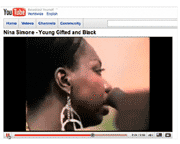
Click on the graphic on the left to launch the video and listen to the song written by Nina Simone/Weldon Irvine.
In-Depth Required Reading
For this week, read the following in your textbook, Diverse Populations of Gifted Children:
- Chapter 8 — p. 124-134
- Chapter 11 — p. 168-173