Enrichment Triad Model
Dr. Joseph Renzulli is a pioneer in the “art” of differentiation. His research and program designs are used world-wide to enhance the learning of gifted children. In the 1980’s Renzulli introduced his Enrichment Triad Model for gifted learners. The goal of the program was to enable teachers to provide programs that would be qualitatively different.
The model consists of three types of enrichment. One important feature is that all students at all intellectual and performance levels can work within the first two types and those activities generated at Types I and II, support Type III.
- TYPE I - General Interest / Exploratory Activities
These activities are designed to provide students with as wide a range of experiences as possible, and include excursions, clubs, interest centers, visiting speakers and brainstorming sessions.
- TYPE II - Group Training Activities / Skills Development
These activities are designed to develop thinking and feeling skills. Students are involved in designing, experimenting, comparing, analyzing, recording and classifying. Skills to be developed include creative and critical thinking, learning how to learn, using advanced level reference materials, and communicating effectively.
- TYPE III - Individual and Small Group Investigation of Real Problems
Students apply the knowledge and skills they have developed while working through Type I and Type II activities. They become investigators of real problems, working on specific areas of study towards presentation to a real audience.
Activities include researching, debating, surveying, making a presentation, writing a journal article, or producing a book or play. Renzulli's Enrichment Triad. Retrieved September 17, 2007, from The Education of gifted and Talented Students in Western Australia
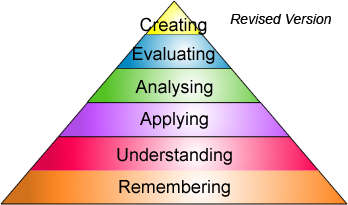 All three types of enrichment found in Renzulli’s Enrichment Triad Model provide for activities from the higher levels of Lorin Anderson’s revised version of Bloom’s Taxonomy. The revised taxonomy is a more authentic tool for planning curriculum, delivering instruction, and assessing progress.