Authentic Assessment
In a classroom featuring differentiated curriculum, you move towards authentic assessment that aims to evaluate students' abilities in real-world contexts. In other words, students learn how to apply their skills to authentic tasks and projects. It does not encourage rote learning nor passive test-taking. Instead, authentic assessment focuses on students thinking analytically, integrating what they learned and expressing their ideas either written or oral. Also, it may include the student's ability to work collaboratively with their peers. Authentic assessment values the learning process as much as the finished product.
Read the Authentic Assessment Overview presentation by Pearson Education Development Group on their web site. It further explains the what, why and how to move away from multiple-choice tests and move towards other methods of evaluating your students' achievement. Authentic Assessment Overview. Retrieved September 25, 2007, from TeacherVision
The Authentic Assessment Toolbox created by Jon Mueller gives us a flowchart in his How Do You Do It? section to guide educators in the development of quality authentic assessments.
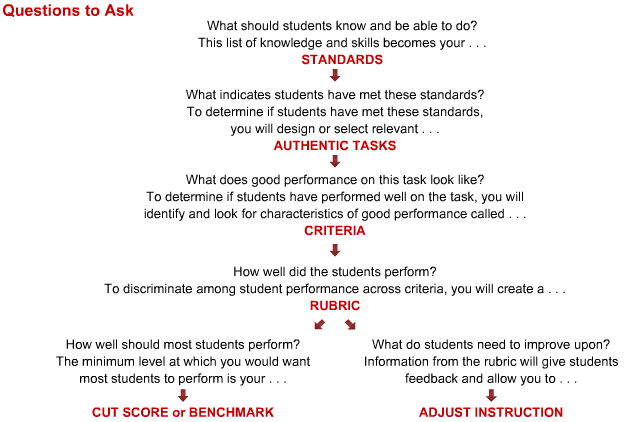
Mueller, John. Authentic Assessment Toolbox. Retrieved September 25, 2007, from Authentic Assessment Toolbox
As you reviewed this flowchart, hopefully, that “aha” light bulb brightly lit up! Technically, you have been assessing your lesson almost every step of the way. Every strategy shared up to this point requires the teacher to informally or formally monitor student progress. You have been conferencing, evaluating, making recommendations, and guiding. The student is continuously performing and you are continuously assessing. In order to go to the next step, you have evaluated their performance, often on a day-to-day basis rather than in a situation where you teach the lesson and then give a test at the end.
This does not mean that you never have to give another end of chapter test or other paper and pencil test. You still have to make sure your students are mastering the standards covered by the general curriculum, but many of your gifted students will have done this by pretesting out of the units. The paper and pencil tests will also satisfy the need for some type of concrete paper trail that most of you are required to maintain.